Primary English · A Parent’s Guide
PSLE English Oral:
What Your Child Needs to Know
Read so the message comes across. Speak so your ideas can be understood.
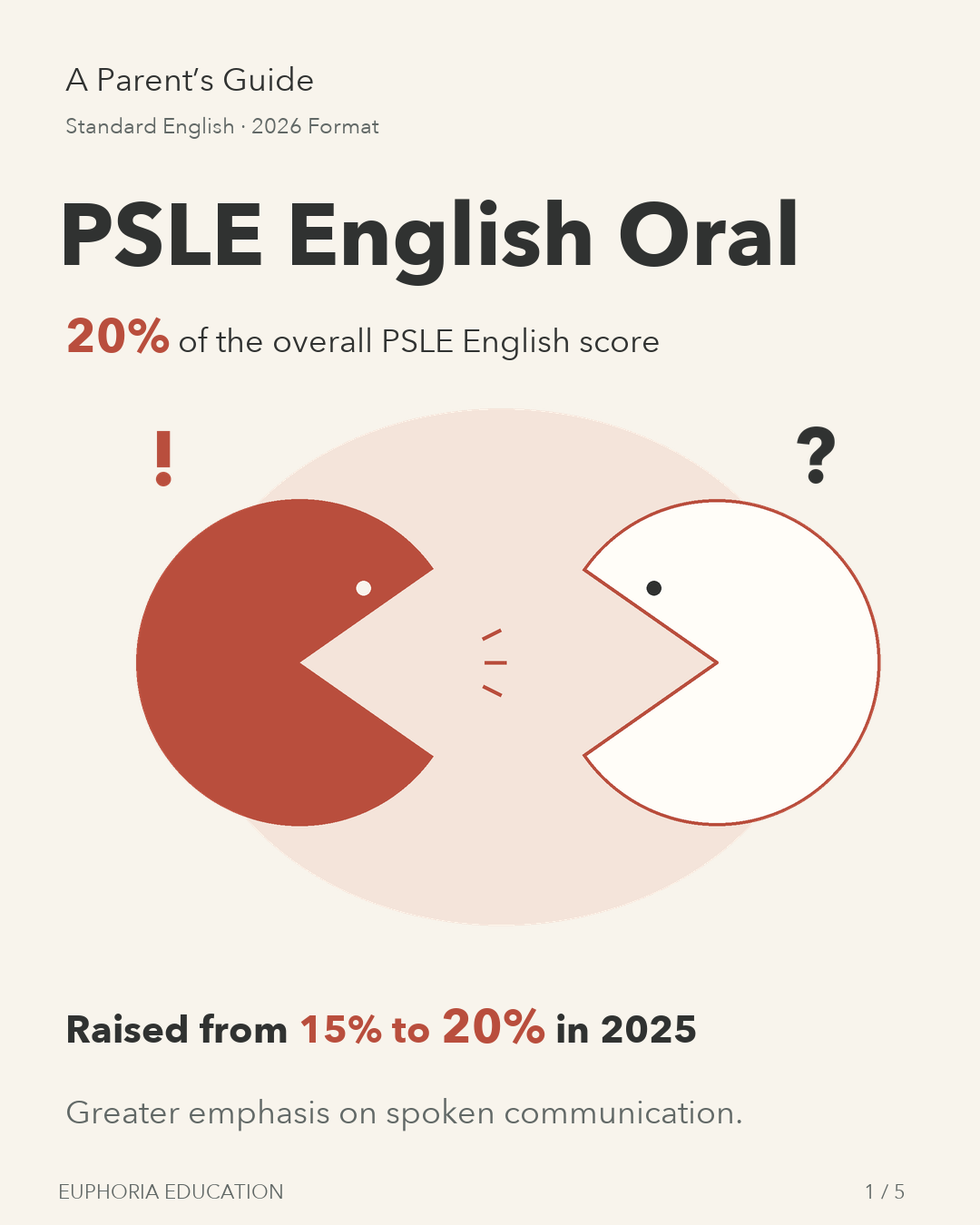
Oral Communication
20% of PSLE English
Since 2025, Oral has risen from 15% to 20% of the total English marks, giving spoken communication greater emphasis.1, 2
Preparation means learning to read with meaning, explain an idea and respond to another person. Here is what the two tasks involve—and what useful practice can look like.
- Reading Aloud
- 15 marks
- Conversation
- 25 marks
PSLE Standard English · Format as of 2026 · The two tasks are not linked by theme.1
Section 1 · Reading Aloud · 15 Marks
Make the Meaning Heard

Your child reads a passage for a given situation. Who is listening, and what is the message meant to do? The reading should suit that audience and purpose.1
Pronunciation
Say the words clearly and accurately.
Fluency
Read smoothly, with pauses that keep meaning together.
Expression
Use tone and emphasis that suit the message, listener and purpose.
A parent-friendly summary of SEAB’s published objectives.1
What Helps a Child Read Well?
Phonics can help children work out unfamiliar words. They also need to hear accurate pronunciation and natural word stress, understand the sentence, and think about the listener.
Section 2 · Stimulus-Based Conversation · 25 Marks
Develop an Idea in Conversation
A photograph provides the starting point for a conversation with the examiners. Your child needs to share relevant views, ideas and experiences, engage the listener, and speak clearly with appropriate vocabulary, sentence structures and grammar.1
Useful preparation gives children practice in listening to the question, explaining their thinking and responding when the conversation moves on.

Five Ways to Explore the Scene
Start With What You See.
Then Think Beyond It.
These are illustrative practice prompts, not actual exam questions or a fixed exam sequence.
- Notice and Explain
What suggests the children are working together?
- Give a View
Would you like to join this activity? Why or why not?
- Recall an Experience
Tell me about a time you helped care for a shared space.
- Consider Others
Why should everyone help keep public places clean?
- Suggest an Action
How could your school encourage pupils to reduce litter?
A Support for Organising Ideas
Use TREES to Build an Answer
TREES is one of several optional teaching frameworks. It gives children ways to develop an answer when they need a little structure.
- Thought
- State your view.
- Reason
- Explain why.
- Example
- Add a relevant detail.
- Experience
- Share a real experience, if useful.
- Suggestion
- Offer an idea, if it fits.
Listen first and choose what fits. Children do not need all five parts in every response. TREES is not an official exam requirement or marking formula; a relevant answer matters more than completing an acronym.
Skills That Grow Together
Build the Language Behind the Response
Word reading, vocabulary, grammar and comprehension all give children more to draw on when they speak. At Euphoria, Primary English individual learning plans connect these language skills, with teaching shaped by each child’s strengths, gaps and school expectations.
The goal is clear communication: understanding what you read, making your meaning heard and having something relevant to say.
Enquire About Primary English