Primary English · A Parent’s Guide
PSLE English Paper 2: The Language Skills Behind the Questions
Grammar, vocabulary, spelling and comprehension do not work in isolation. Paper 2 asks children to bring them together.
A child might need to choose a precise expression, reshape a sentence without changing its meaning, or explain an idea using clues in a passage. Each task draws on language knowledge—not just familiarity with a question type.
Here is a closer look at the skills behind the components.
One Paper, Connected Skills
PSLE Standard English · Format as of 2026 · Official SEAB format
| Component | Marks |
|---|---|
| Booklet A · Multiple Choice | |
| Grammar | 10 |
| Vocabulary | 5 |
| Vocabulary Cloze | 5 |
| Visual Text Comprehension | 5 |
| Booklet B | |
| Grammar Cloze | 10 |
| Editing for Spelling and Grammar | 10 |
| Comprehension Cloze | 15 |
| Synthesis / Transformation | 10 |
| Comprehension OE | 20 |
The table separates exam components, not the knowledge children use. Vocabulary also supports comprehension. Grammar helps children follow a complex sentence as well as complete a grammar question.
01 · Grammar and Grammar Cloze
Knowing What Fits—and Why
Grammar is more than choosing the option that “sounds right”. Children need to understand how subject–verb agreement, tense, verb forms, pronouns, prepositions and connectors work within a sentence.
In Grammar Cloze, that knowledge must work across a passage. The surrounding meaning and sentence structure help determine which form belongs in the blank.

Read question text
Humans have always (30) fascinated by animals
Answer: been
The present perfect uses have / has + a past participle. Been is the past participle of be, so the phrase here is have always been. Understanding the structure is more useful than memorising an answer to this one sentence.
The example shows a selected sentence, not the full passage or word bank.
02 · Vocabulary and Vocabulary Cloze
Meaning Changes With Context
A wide vocabulary includes precise word meanings, expressions and the ways words combine. In Vocabulary Cloze, children must also follow the passage to decide which choice fits the context.

Read question text
His new restaurant because he had no idea of how to run a business.
- paid off
- sold out
- backed off
- went under
Answer: went under — the business failed.
Phrasal verbs are one part of vocabulary. Knowing the separate meanings of went and under is not enough to understand this expression.
The goal is to understand and use words and expressions in context—not simply accumulate a list of difficult words.
03 · Editing
Spelling and Grammar Meet on the Page
Editing brings two different demands together: recalling a word’s spelling and recognising the form that the sentence needs.
Remember the Written Word

Read question text
Grandma had a pair of old glasses which she had worn for over a deckaide.
deckaide → decade
Retrieve the spelling of the word for a ten-year period.
Recognise the Word Form

Read question text
With every describe, Grandma’s spirits lifted.
describe → description
Here, the phrase after with needs a noun: every description. The verb describe does not fit this sentence.
Sound–spelling knowledge helps, but it does not make every spelling predictable. Children also need knowledge of written words and word parts—and the grammar to recognise when a different form is required.
04 · Synthesis and Transformation
A New Structure, the Same Meaning
Rewriting a sentence is not just swapping one word for another. Children must use the required structure while preserving what the original sentence says.
Rewrite with the given opening. Keep the meaning.

Read question text
Completing the project requires at least ten days.
A minimum period
A minimum period of ten days is required to complete the project.
At least becomes a minimum. The focus shifts to the time needed, so requires becomes is required—the passive form. Period is singular, so the verb is is.
Several decisions must hold together: sentence structure, agreement, verb form and precise meaning.
05 · Comprehension Cloze
No Word Bank to Lean On
Children supply the missing words themselves. They need to understand the whole passage, recognise contextual clues and retrieve words that fit both the meaning and the sentence structure.

Read question text
Some people are (53) reliant on their smartphones that they find it hard to put them (54) even for a little while.
Language Patterns to Notice
so … that
Connects degree and result.
put them aside
Stop using the phones for a while.
A connector may express a reason, contrast or result. A preposition may belong to a familiar phrase. Reading only the words immediately beside a blank can miss a clue elsewhere in the passage.
This is not vocabulary alone—or grammar alone. Children must bring both to their reading.
06 · Visual Text Comprehension
Read the Message, Not Just the Details
Reading a poster or article involves more than locating a date or copying a phrase. Children may need to identify a central message, compare ideas, infer meaning or work out the writer’s purpose and intended audience.
The examples below show three different reading demands. Some ask the child to read one text; another asks them to connect ideas across a poster and a continuous article.
Main Idea
Identify the central message.

Read question text
What is the main message of Text 2?
Comparing the Texts
Connect an idea expressed in both texts.

Read question text
Which idea is expressed in both Text 1 and Text 2?
Purpose
Work out why the text was written.

Read question text
What is the main purpose of the article?
These multiple-choice question stems illustrate different reading demands. Their options and full texts are not shown; no answers are supplied here.
07 · Reading Comprehension
Different Responses, Overlapping Skills
Children may select from supplied options or construct an explanation of their own. Either form can involve inference. A constrained answer is not necessarily a simple factual question.
Structured Responses
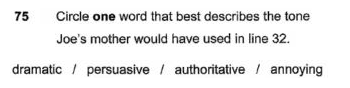
Select from given options using clues in the passage. Here, the child must circle one of four supplied words. The response is constrained, but choosing still requires interpreting tone.
Read question text
Circle one word that best describes the tone Joe’s mother would have used in line 32.
Open-Ended Responses
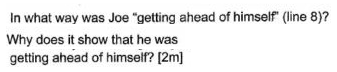
Interpret and explain meaning in context. The child constructs an explanation rather than selecting a supplied answer.
Read question text
In what way was Joe “getting ahead of himself” (line 8)? Why does it show that he was getting ahead of himself? [2m]
Both draw on vocabulary, close reading and meaning in context. The difference is how the child responds—not whether thinking is required.
“Structured” describes the response format here, not a separate exam component or marks category. The official 20-mark component is Comprehension OE. The passage and answers are not shown here.
The Bigger Picture
Language Takes Time to Grow
These skills build on one another across the primary years. A richer vocabulary supports understanding. Grammar helps children follow and reshape complex sentences. Accurate spelling and punctuation help them express ideas clearly.
For younger children, building those foundations does not mean starting P6 papers early. It means wide reading, discussion, explicit teaching and regular opportunities to use what they have learnt. For a child already in upper primary, begin with what they understand now and the next skill they need.
The useful question is not only “How many papers has my child completed?” It is “What language knowledge can my child now understand, explain and use?”
At Euphoria, Primary English individual learning plans connect grammar, vocabulary, spelling, reading comprehension and writing. We teach concepts explicitly and help children apply them beyond the first exercise. These are useful language skills for PSLE—and for children learning in other school systems, whose assessment formats may differ.
Sources and Scope
Format checked against the SEAB 2026 Standard English examination format on 25 October 2026. Foundation English has a different format.
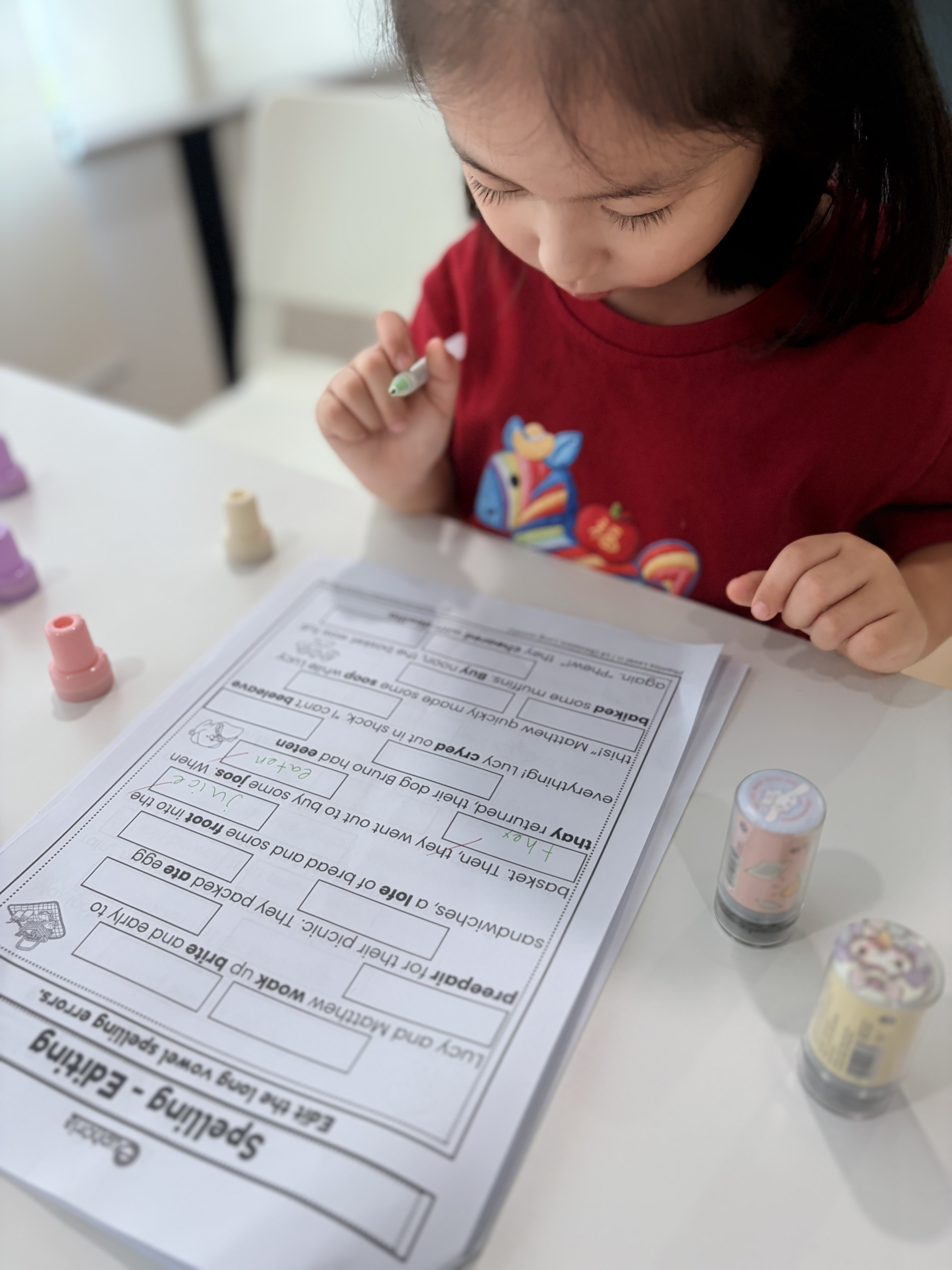
Explanations and teaching completions are educational illustrations, not an official marking scheme or predictions of future questions. The classroom photograph shows a learning activity, not a PSLE examination.