Reading · Spelling · Writing
My child reads fluently—why can’t he spell or write?
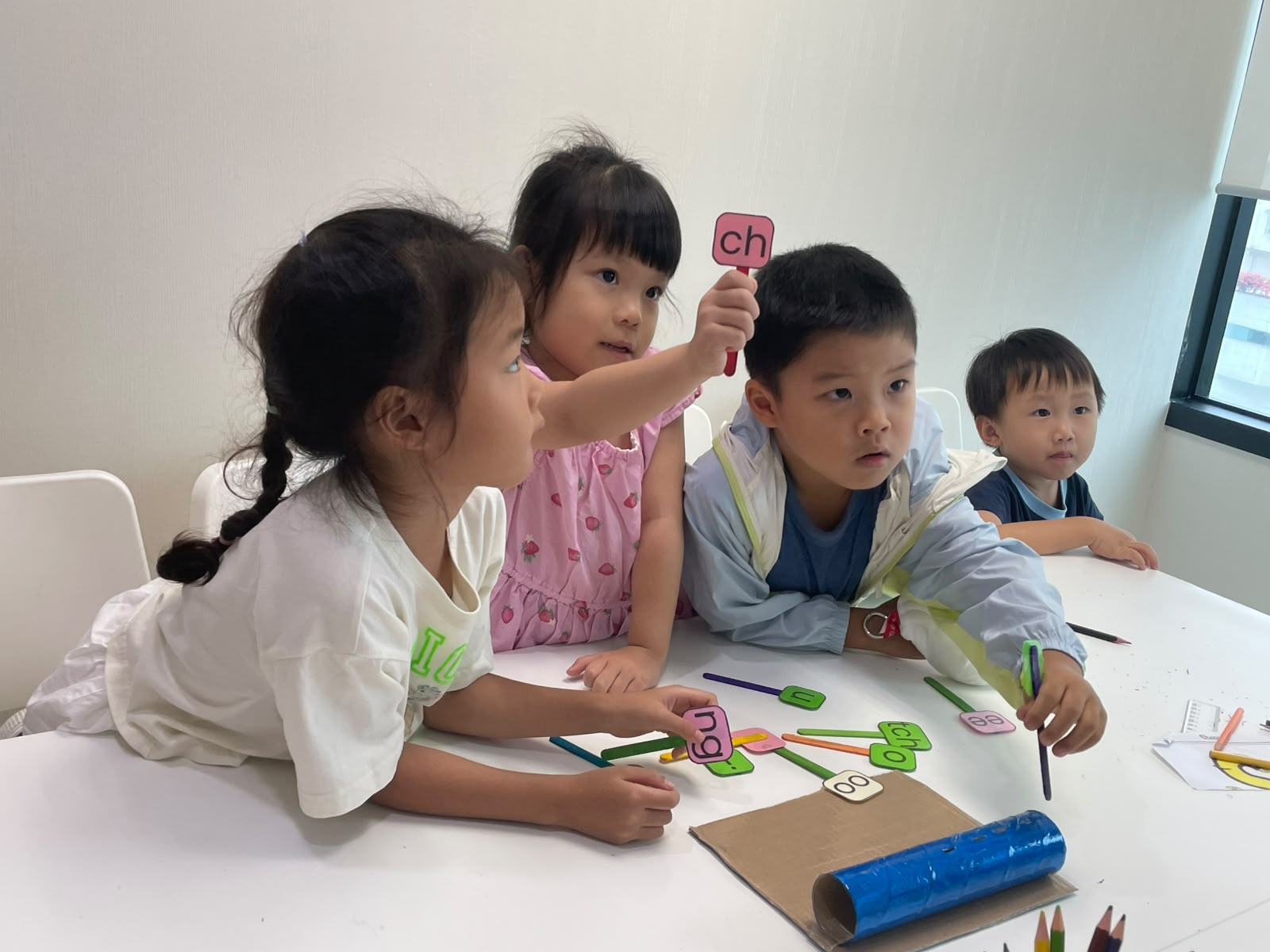
Your child reads confidently—but still asks, “How do I spell it?” Reading a word and spelling it independently are different demands. Here are two patterns we see in the classroom.
1. Relying on familiar words, without a sound–spelling system
Some children read familiar words confidently after repeated exposure and memorisation, without having been explicitly taught how sounds connect to letters and letter groups.
There is nothing wrong with picking up reading through books or learning words from school spelling lists. But without a secure sound–spelling system to draw on, tackling unfamiliar words and spelling independently can depend heavily on memory and repeated drilling.
Copying a word ten times is not the same as knowing how to spell it. A child may reproduce the letters while the word is in front of them without practising how to identify its sounds and recall the spellings themselves.
At Euphoria, we do not rely on exposure or rote memorisation alone. We explicitly teach children to connect letters to sounds for reading, and sounds to letters for spelling—known as phonics-based encoding. They practise recalling and using those connections, so memory is supported by a system rather than a separate spelling list for every new set of words.
2. The phonics is familiar, but it is not yet being used in writing
Other children have learnt phonics and can use it to read, but do not yet reliably apply it when writing.
When reading rain, the letters r–ai–n are already there. When spelling it, the child must identify the sounds and recall which letters to write. Recognising ai on the page does not automatically mean they can produce it without a prompt.
The long-a sound can be written ai in rain, ay in day or a_e in cake. A child who reads rain but writes rayn may know how to represent the sound while still needing to learn which spelling belongs in that word.
We also teach children to spot where spelling patterns tend to appear. For the long-a sound, ai is often found in the middle of words, as in rain and train, while ay often comes at the end, as in day and play. These are useful clues, not a rule that decides every spelling: cake uses another pattern, a_e.
Decoding means using letter–sound knowledge to read a word. Encoding means identifying the sounds in a spoken word and choosing letters to spell it.
Children need practice in both directions: reading the pattern, then recalling and writing it without the answer in view. We revisit it across words and sentences so it becomes knowledge they can use, not just recognise.
A spelling difficulty alone does not tell us its cause. We check what the child can recognise, recall and apply before deciding what to teach next.
What does useful practice look like?
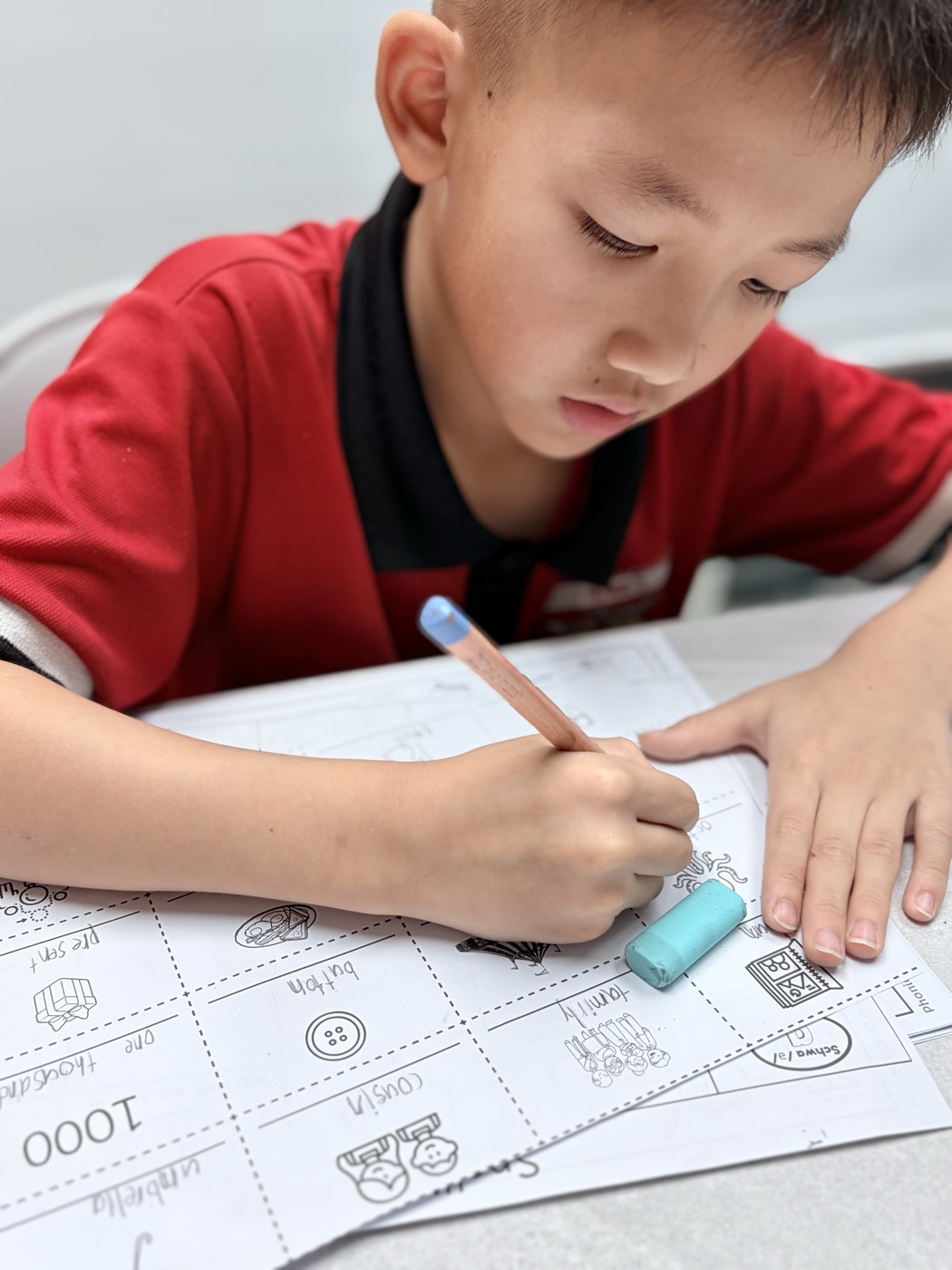
Start with a word and pattern your child has already been taught. Read it together and notice the letters representing each sound. Then put the written word away, say the word and let your child try to spell it.
If they are unsure, help them revisit the particular connection they have forgotten, then give them another opportunity to recall it. Later, return to the word in a short sentence appropriate to their level.
The aim is not simply to copy a correct word several times. It is to find out what your child can recall and use when the model is no longer there. Keep home practice brief and follow the teacher’s guidance; you do not need to teach a new set of patterns yourself.
And why can writing still feel difficult?
In Primary English, writing brings many skills together:
- Spelling accuracy: getting the intended words onto the page correctly.
- Grammar and punctuation: constructing clear sentences, keeping tenses consistent and showing where ideas begin and end.
- Ideas and organisation: deciding what to say and arranging it in a logical sequence and structure.
- Vocabulary: choosing words that express the intended meaning precisely.
- Expression and detail: bringing writing to life through purposeful adjectives, vivid verbs, actions and other “show, not tell” techniques—not simply adding more descriptive words.
Different types of writing also call for different choices. Telling a story, explaining a process and writing a persuasive message do not all use the same structure or language. Children need to learn how to adapt their writing to its purpose and reader. These demands extend beyond spelling into composition.
A fluent reader may still need explicit teaching and guided practice in these writing skills. We build them alongside one another; children do not have to perfect spelling before they begin expressing ideas.
How Euphoria builds the connection
In Preschool Phonics, children learn sound–spelling connections through a structured progression, with practice in both reading and spelling, followed by sentence writing.
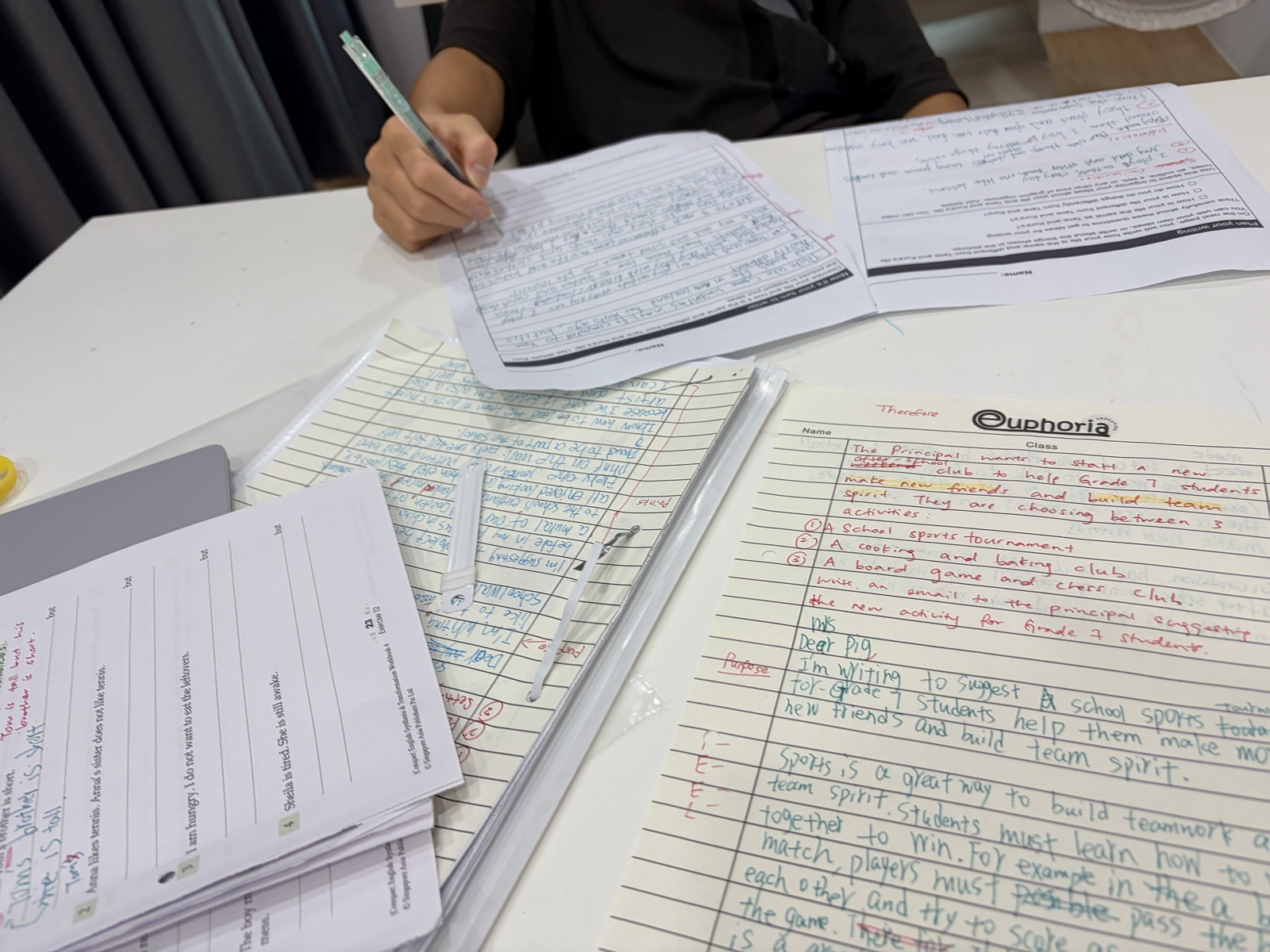
In Primary English, each child’s individual learning plan targets the gaps behind their spelling and writing difficulties. This can include:
- Phonics-based spelling and pattern recall: connecting sounds to spellings and applying them independently, including advanced graphemes and meaningful word parts such as suffixes.
- Sentence construction, grammar and editing: applying concepts consistently in their own sentences, then recognising and correcting errors.
- Writing and composition: planning and organising ideas, selecting vocabulary and using “show, not tell” techniques to develop a piece of writing.
In groups of no more than four, teachers explain the relevant concepts, guide purposeful practice and check independent application. The plan responds to what the child needs—not just their school year or the next practice paper.
The goal is not only to recognise what has been taught. It is to recall it and use it independently.